

When it comes to the philanthropic ecosystem, we live in exciting times. A duo of recent posts — one from one of SF’s great thinkers, the other from one of its great general managers — are dedicated to this fact.
Last week, Dwarkesh Patel closed submissions for a blog prize searching for the best answers to the question: How do we deploy (possibly) hundreds of billions of dollars to “make AI go well?” He specifically wanted to know how readers might approach the problem of converting money into impact from the POV of the OpenAI Foundation.1
In a second blog post, The third wave of American philanthropy, Stripe Climate GM Nan Ransohoff put the scale of the opportunity in context. She points out that if $50 billion from AI donors were to enter the philanthropic ecosystem each year, that would be enough to fund the annual budgets of the following organizations:
6 Gates Foundations (~$9B/yr), or
67 Coefficient Givings, formerly OpenPhil (~$1B/yr), or
100 GiveWells (~$500M/yr), or
333 Arc Institutes (~$150M/yr), or
5000 Institutes for Progress (~$10M/yr)
Nan then breaks down the challenge into a set of seven subproblems that, from an ecosystem design perspective, we must overcome to use these dollars well. Today’s piece zeroes in on a solution to one of these problems: figuring out how these new funders can leverage their unusually large risk appetites to world-changing effect.
Incidentally, this is exactly what my submission to Dwarkesh’s blog competition was about. In it, I profiled the best scientific philanthropist of all time, Warren Weaver, and his (exceptionally risk-tolerant) playbook for willing new fields into existence. Like great VCs, he only took big swings. Unlike VCs, he did next to no diversification. To Weaver, field creation was an endeavor that required focus; responsibility was not about hedging your bets, but giving carefully selected fields everything they needed to flourish.
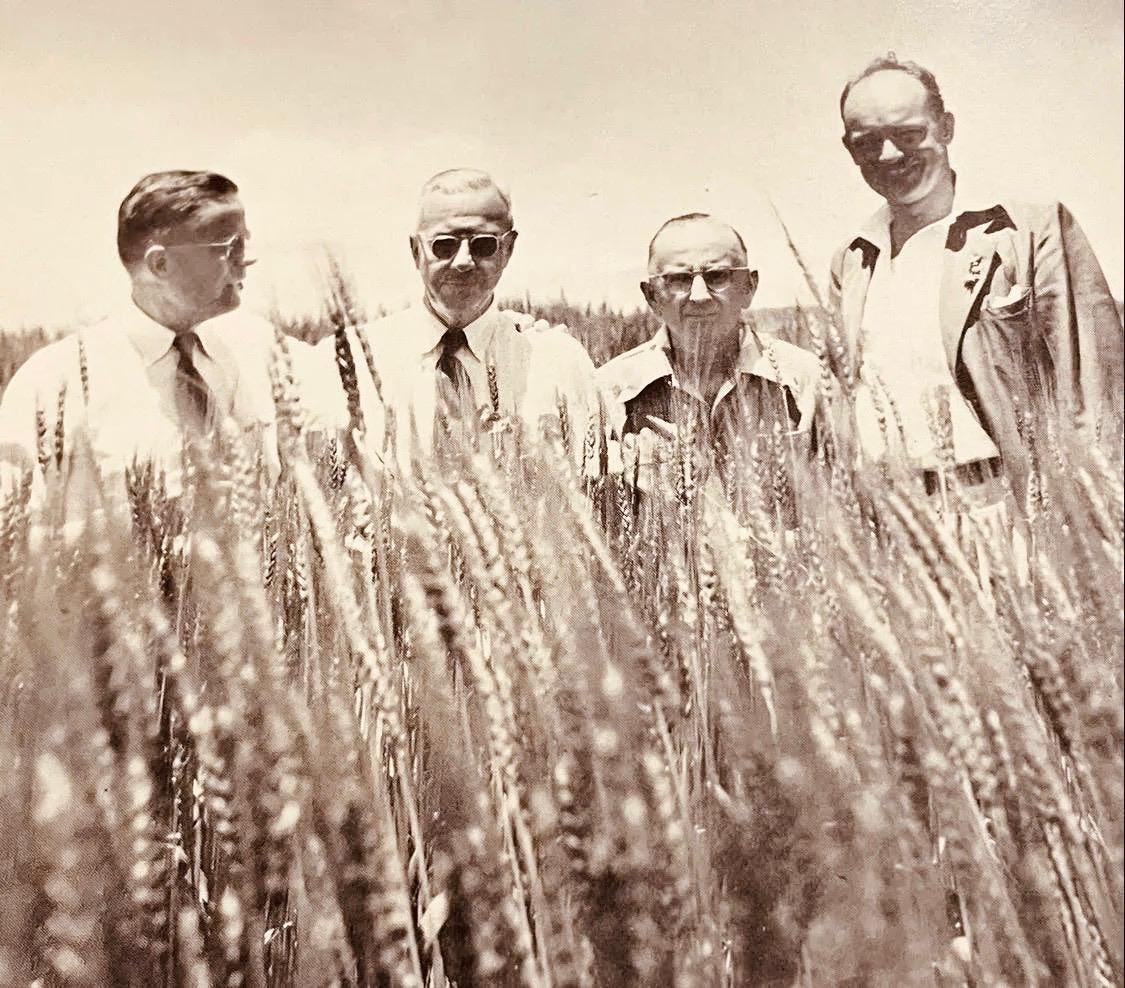
Over the course of twenty years, Weaver bootstrapped the field of molecular biology into existence. He then funded a course of crop research that would grow into the Green Revolution. Weaver had the courage to live with concentrated bets for years on end, and the world is immeasurably better for it.
Given the blog competition word count, I’m briefer than usual in many spots. If you’re curious to learn more about any topic mentioned, check out my long piece on Weaver, my many Weaver tweets, or ping me. And if you have the urge to act on today’s piece, contact me — egillia3@alumni.stanford.edu, or on my Twitter. If urgent, I can fly to SF.
Two more of Nan’s subproblems — (1) the need to create new philanthropic capital allocators and (2) to make the problems that need solving more legible — will be the subject of a coming piece.
A Technology of Historical Consequence
To become a technology of historical consequence, we must proactively make good things happen using AI. In the not-so-distant past, we find kinks in mortality graphs representing hundreds of millions of lives saved — kinks sparked by the action of a few smart people. Human brains did that. In partnership with a superhuman AI, we should have no less ambition.
Our ambition should extend beyond longer, healthier lives. I take a somewhat Robert Gordonian view of human flourishing: people working less without getting poorer, finding ways to make housing and food more affordable, and so on.
In pursuit of these goals, the philanthropic efforts of the AI labs should focus on problems that take advantage of two Silicon Valley comparative advantages: R&D and risk-tolerant capital allocation.2
Key individuals at the OpenAI Foundation have the opportunity to cement themselves as historically great, as more consequential than even J.C.R. Licklider or Bell Labs’ Mervin Kelly. But to do so, they must internalize the lessons of history’s best research funders. Why? Turning money into impact is closer to a problem of organized complexity than one of simplicity. Working from empirical data trumps “first principles” in areas of this sort. Funders need to decide on some heroes, and learn from them.
If I ran the OpenAI Foundation, a photo of Warren Weaver would hang in the lobby. From his perch at the Rockefeller Foundation, which he took over in 1932, Weaver made two contributions that cement him as the greatest scientific grant funder of all-time. He:
Funded molecular biology into existence.
Was key in funding the Green Revolution into existence.
(If the reader wonders whether Weaver simply got lucky twice, he also spotted the computing wave. Purchase the book-form of Claude Shannon’s The Mathematical Theory of Communication, and you’ll find that Weaver is co-author. Search for the grant that funded the 1956 Dartmouth Summer AI Conference, “Weaver.”)3
I’d structure the foundation to empower modern-day visionaries deploying the Weaver playbook. The playbook, in a line: true specialization in an extremely young field.
True Specialization in an Extremely Young Field
How young is young?
In the case of molecular biology, ~80% of Weaver’s Natural Sciences Division budget went into the field for ~two decades pre-Watson and Crick. For the first five years, many key experiments didn’t run or barely worked. They fell forward. Even in 1948 — 15 years into this focused bet, 5 years pre-Watson and Crick — one could find Leo Szilard hemming and hawing over whether it was too risky to enter such a young field.4
How did Weaver choose to specialize in molecular biology?
Weaver, an applied mathematician, worked in physics during the era in which physics’ tools and models fruitfully invaded chemistry.5 He believed a branch could be similarly willed into existence at the intersection of biology and physics.6 Biology, at that point, was a ~single instrument field — the optical microscope. Biologists didn’t work at the small scales physicists had now learned to study. A biological question on the scale of heredity was the perfect place to start.
Why specialize?
Before Weaver arrived, the Natural Sciences Division operated somewhat typically. They let scientists line up in general areas, and funded the best ideas until money ran out. Weaver saw that as inefficient, and believed focus would be super-additive. “A highly selective procedure is necessary if the available funds are not to lose significance through scattering.”7
It worked. By 1965, 18 Nobel Prizes would be given out for molecular biology. 15 of them were beneficiaries of Rockefeller Foundation funding, on average receiving their funds ~2 decades in advance of the prize — in an era in which scientists won the prize in middle age. Weaver would then move all his chips into his next branch, one that would grow into the Green Revolution.8
Courage and Trust
I’ve simplified a bit.9 Still, the simplicity of the approach begs the question: “Why doesn’t everyone do it?”
The answer is likely also simple: courage and trust are in short supply. The field Weaver tied up almost all his money in did not have a name — he named it “molecular biology” in 1938. The bet was overseen by someone named “Weaver,” not “Rockefeller.” And he didn’t have all that much to show for it in the early years. The bet is unthinkable at almost every large philanthropy today. Most who tried would get impatient, scared, or fired before the seeds bore fruit.10
But it can be done. AI’s philanthropists have enough money to fund multiple Weavers at once, but not enough to diversify their way to Weaver.11 The work will require courage and a steady hand; it’s a Berkshire Hathaway-style portfolio of focused bets.12
Areas of Opportunity
How to choose which could-be Weavers to empower? Focusing on areas where the R&D funding ecosystem systematically under-invests is a natural approach. Several include:
New Field Creation
Instrumentation
Doing-Heavy Discovery Work
AI might give us better next experiment ideas in biology, but that doesn’t change the structure of the NIH or the incentives of VC. NIH panels can err towards consensus work in fields that already exist, and VCs toward things that are VC-profitable within 10 years. Neither specializes in creating new molecular biologies. The OpenAI Foundation can, if it chooses.
On instrumentation, neither academia nor VC fund biological tooling at a societally optimal level. The status quo may deliver super-human intelligence that is wildly under-sensed. There’s surely a Weaver who would dedicate themselves to the problem.
Opportunity also exists beyond AIxBio. Doing-heavy discovery work is under-emphasized in general; for example, crop test fields for construction are not a university specialty. A related historical example worth dredging up comes from the memoir of James Killian, my least favorite dead MIT President. Polaroid cofounder Edwin Land once proposed that, at MIT’s Sloan School, Killian “establish a model company — a practice school — to explore other ways to create other noble prototypes of industry.” That strikes me as a good problem for a Weaver in the age of AI.
Thanks for reading.
Stay tuned for my piece on founding new philanthropic capital allocators that scale, and doing so in not-yet-legible areas of R&D, coming in early June.
FreakTakes is, in many ways, a ~200,000-word exploration of exactly this — from several dozen different angles.
Naturally, this piece is primarily focused on those eager to focus their philanthropy on R&D. This is, after all, an R&D history Substack. And even among those giving to R&D, there are obviously heroes you can pick other than Weaver! J.C.R. Licklider (of early BBN and ARPA fame) and MIT c. 1920 are both worthy heroes, for example. I’ve written longer FreakTakes pieces on both.
In the next couple of months, I’ll also publish a piece breaking down why Weaver, in the 1940s, thought it was clear that the computer would eventually cement itself as one of (if not the) most important instruments in the study of biology.
This Substack’s original Weaver piece spends many thousands of words detailing what I had to distill in a few sentences here. So if you want to hear stories from the nascent labs, breakdowns of Rockefeller budgets before and after Weaver’s arrival, and how he used the other 20% of his portfolio to explore areas that could become his next branch, see that piece.
Many who read this Substack will be familiar with the fact that the physicists and chemists won each other's Nobels quite frequently, in this period.
To my eye, this heuristic for field creation feels timeless. Heuristics only take you so far, but it’s a great place to start.
Weaver felt that philanthropic divisions (like his) were not above the sort of specialization expected of firms. He focused his funds where they were needed, giving the young (speculative) field he was building the resources it needed to flourish. New Silicon Valley funders will be well-placed to impose this focus on specific activities happening in an organization. But doing so in the service of long-term, (often) not very measurable goals might be a bit of a balancing act. Empowering single individuals, as companies do with executives, is essential. But extending them more rope than is typical of executives is also essential if you want a Weaver. Most philanthropies, frankly, do not have the stomach to fund a Weaver. I write this piece in the hopes that a few will have the stomach and steady hand to do so.
As I wrote in the conclusion of my original Weaver piece: “Weaver was not committed to molecular biology at the expense of all other things. He was committed to creating high-value branches at the expense of all other things.
The Division would not abandon its young branch — molecular biology — because it was not publicly producing in a way that would make headlines, but they would abandon their baby if they felt it didn’t need them anymore. There had to be some new, undiscovered branch out there in need of their support. The follow-on funders could take it from there.
For some people, like Weaver and Szilard, life’s too short to spend basking in the glory of what they’ve built. They’d rather do the damn thing again.”
Of course, Weaver didn’t do it alone. He relied on excellent field strategists, most prominently Max Delbrück and Salvador Luria, who recruited and pitched great young people into the field one at a time, over many years. And many other key Weaver practices contributed to the success. For example, he deeply studied the field, maintaining a sense of what failures were productive vs. dead ends. Etc. Etc. Read the longer Weaver piece to learn more about all of this.
This is a real problem. The solution to which one might be just as likely to find in religion and folk wisdom as in any business or R&D history book. The mechanism by which courage and patience, for the long haul, are created in individuals is curious. For modern exemplars of steady-handed confidence of this form, I’d recommend watching several dozen hours of Warren Buffett and Charlie Munger reacting to the manias, panics, and fads of their times.
Upon reading Nan’s piece, I might hedge this statement a bit. I was imagining yearly giving numbers more in the ~$5 billion range, give or take. But even if it were ~$1 billion per year, upon further reflection, that might be enough to diversify your way to Weaver in cheaper subject areas. A social science-flavored focus would be one example where this could be possible. Computational law, computational applied history and experimental history, and the “noble prototypes of industry” idea mentioned in the conclusion are all areas that could potentially warrant their own Weaver.
It should be noted that Weaver, Buffett, and Munger are all aggressively Midwestern — a factor this Midwestern author finds material. In his life, Munger made an unwieldy number of quips along the lines of, “The big money is not in the buying or the selling, but in the waiting.”
Great post! Looking forward to more.